
Weather Conditions and Air Quality Index (AQI)
Ozone Season Updates Can Be Found on the Ozone Design Value Webpage
What Is The AQI?
The Air Quality Index (AQI) is a color-coded scale designed by the EPA to report and communicate forecasted and current air quality – think of it as a weather forecast for air pollution. It takes the main air pollutants regulated under the Clean Air Act into account with each pollutant contributing to the final AQI value which is assigned a specific color to convey the historical, current, or future air pollution level. The AQI is not the same as ozone measurements or the ozone design value.
Weather conditions have an enormous effect on pollution levels. Examples: High temperatures and direct sunlight promote the formation of ozone; particulate matter concentrations decrease through rain.
The current weather conditions to complement the air quality conditions are summarized in the table below; scroll further for the latest AQI forecast.
 Plan Ahead: Air Quality Forecast
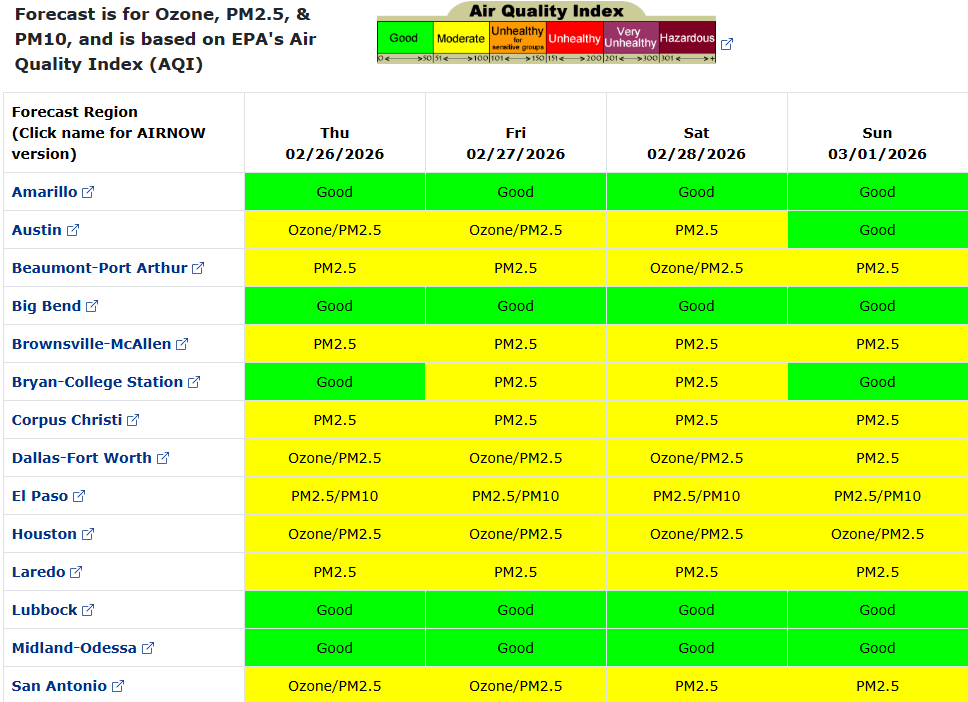
The air quality forecast for the coming days for the DFW area, courtesy of AirNow, is shown in the following table.
How The AQI Is Calculated
Each considered pollutant has a separate AQI scale, with an AQI rating of 100 corresponding to the concentration of the Federal Standard for that pollutant. The pollutants factored in are ozone (O3), particulate matter (PM2.5 and PM10), carbon monoxide (CO), sulfur dioxide (SO2), and nitrogen dioxide (NO2). The index calculation is different for each parameter measured and is specified by the EPA - for more details visit EPAs AQI website. The main pollutants of concern in the DFW region are ozone and fine particulate matter; on hot summer days, the AQI is often driven by ozone, while winter spikes are more often related to PM2.5.
The table below focuses on the breakpoints for these pollutants when calculating the AQI.
Additional information about the AQI and how it can be used is available on EPA's AirNow website.
For in depth details on reporting and calculating the AQI, consult the AirNow Technical Assistance Document for the Reporting of Daily Air Quality – The Air Quality Index (AQI), authored by the EPA.
Air Quality Index Values and Pollutant Concentration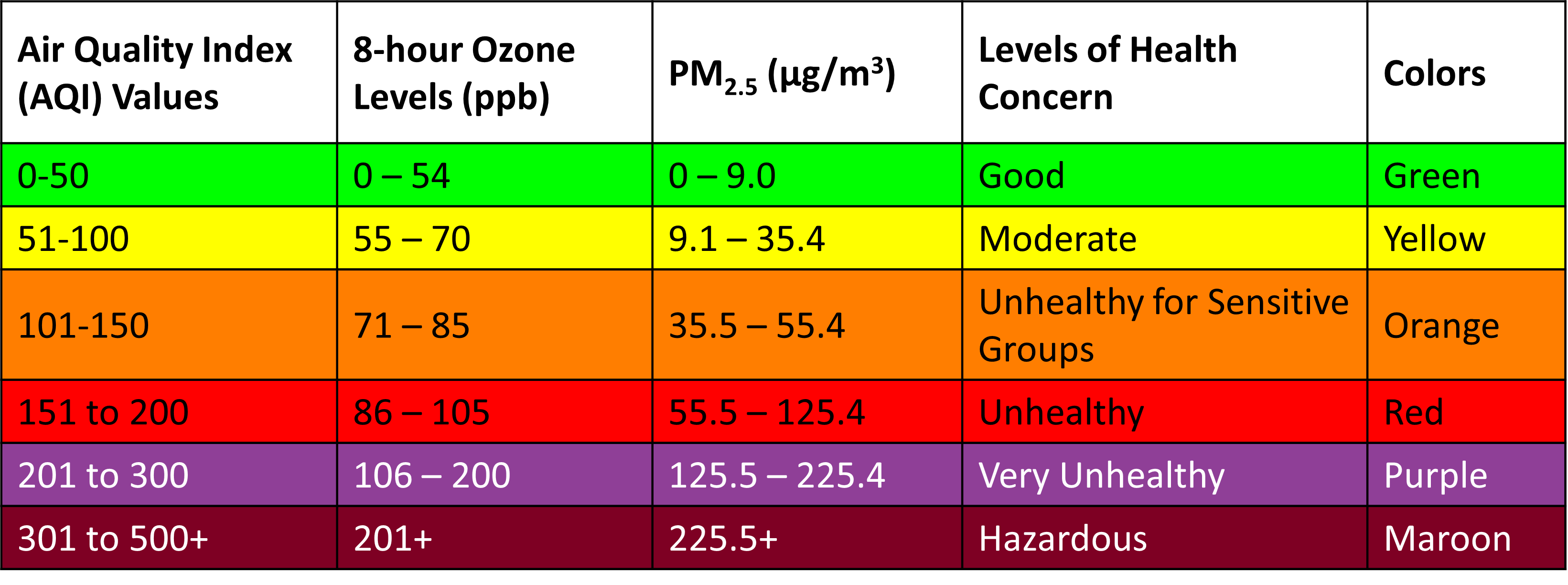
Interpreting the AQI
With the AQI the EPA has created an overall simple interpretation tool by being able to communicate the approximate status of the air through a color, similar to traffic lights – "go, caution, stop!" – with some additional differentiation.
An AQI level of Orange or Red does not necessarily indicate that no outdoor activity is possible, but it calls for enhanced caution, more breaks and a higher awareness, including monitoring of one's physical state when being outside. This is especially true with high temperatures, which pose an additional strain on the body.
Generally, the colors translate to the following conditions.
| Green | Safe conditions for everyone. |
| Yellow | Sensitive individuals may want to limit exposure and monitor their bodies. |
| Orange | Children, elderly, and those with respiratory issues may want to limit exposure and monitor their bodies. |
| Red | Everyone may start to feel effects of exposure. Turn down a gear. |
| Purple | Health warning for the entire population. Limit exposure. |
| Maroon | Emergency conditions. Everyone is at risk and should avoid extended exposure. |

For the status of the current ozone season 2026, visit the Ozone Design Value page.
Visit our Ozone Information page for everything ozone and the 2025 Air Quality Handbook for a deeper insight on a comprehensive and multi-pollutant approach on air quality improvements in the DFW region.
Go here if you are interested in Air Quality and Health resources, visit our Health and Monitoring Task Force.
Sign up for air pollution alerts and learn how you can help improve air quality at www.AirNorthTexas.org.
Please contact Daniela Tower with any other questions.