
Heat & Air Quality
When Temperatures Rise, Air Quality Can Fall:
A Practical Guide for Hot Days
Extreme heat is more than uncomfortable. It can strain the body, worsen existing health conditions, increase ground-level ozone, and overlap with wildfire smoke.
Heat safety is about more than the forecast. It is a health, air quality, cost of living, and daily life issue. A little planning can lower the risks.
The Connection: Weather Conditions have a Major Effect on Pollution Levels
Heat and air pollution can build on each other. Heat does not automatically mean that the air is polluted, but the weather patterns that produce very hot days can also favor the formation and buildup of pollutants. This can expose people to heat stress and unhealthy air at the same time.
What happens on a hot polluted day?

An important distinction: Heat itself is not an air pollutant, and ozone is generally not emitted directly. Ground-level ozone forms when nitrogen oxides (NOx) and volatile organic compounds (VOCs) react in sunlight. Temperature, sunlight, wind, mixing, and the available precursor emissions all influence how much ozone develops.

Hot, sunny weather favors ozone
Ground-level ozone is created through photochemical reactions involving NOx and VOCs. Strong sunlight drives those reactions, and higher temperatures often make ozone formation more efficient. This is why ozone is frequently highest on hot summer afternoons.

Extreme heat can overlap with smoke
Hot, dry conditions can increase wildfire potential and help fires spread. Smoke can travel far from the fire and contains fine particulate matter, gases, and other pollutants. Fine particles can reach deep into the lungs and affect the heart and respiratory system.

Stagnant air limits dispersion
Persistent high-pressure systems can bring heat, light winds, and limited vertical mixing. With less fresh air moving through, locally emitted pollution can accumulate. The coolest hour is not always the cleanest, so check both conditions before outdoor activity.
Why This Combination Matters
Heat makes the body work harder to stay cool, while ozone and particle pollution can stress the lungs and cardiovascular system. Exposed to both, outdoor activity can get more strenuous and may pose a greater health burden than either hazard alone.
Emissions Feedback to Current Conditions
Very hot days increase electricity demand for air conditioning. Where additional electricity comes from fossil-fuel generation, emissions of NOx and other pollutants may rise. The size of this effect varies with the local power supply, controls, demand, and weather.
A personal heat + action plan
"Stay cool" and "drink plenty of fluids" only helps when resources are known and available. Know where to go, how to get there, what support is available, and what you may need.
 Before
Make a two-condition plan
Check both the heat forecast and the Air Quality Index. Save a cool indoor place you can reach, plus a backup with cleaner air. Make sure you have what you need, such as water or medication.
 During
Reduce heat and exposure
Move activity to a cooler, cleaner time or place. Rest often, drink water, use shade, and follow local health guidance.
 Together
Check on someone
Call, text, or visit a person who lives alone, lacks reliable cooling, works outside, or may need help getting to relief.
At Home: Cool the Space & Clean the Air
- Block daytime heat: close windows and shades before it gets hot outside.
- Use cooler night air carefully: open windows only when outdoor air is both cooler and reasonably clean.
- Filter smoke: use a portable air cleaner or a compatible MERV-13-or-higher HVAC filter.
- Know when to leave: if your home cannot stay safely cool, go to a library, community center, cooling center, or another air-conditioned place.
 During smoke and extreme heat, cooling is essential. EPA notes that for most people, extreme heat is the more immediate danger.
Risk is Not Evenly Shared
Exposure, health, housing, income, transportation, work conditions, social network, and access to trusted information all affect a person's ability to stay safe.
- Older adults and people living alone
- Infants, children, and pregnant women
- People with heart or lung conditions
- People taking medications that affect heat tolerance
- Outdoor workers and athletes
- People without reliable cooling or stable housing
If you experience or see warning signs: act early and act fast! Heat stroke is an emergency.
What to do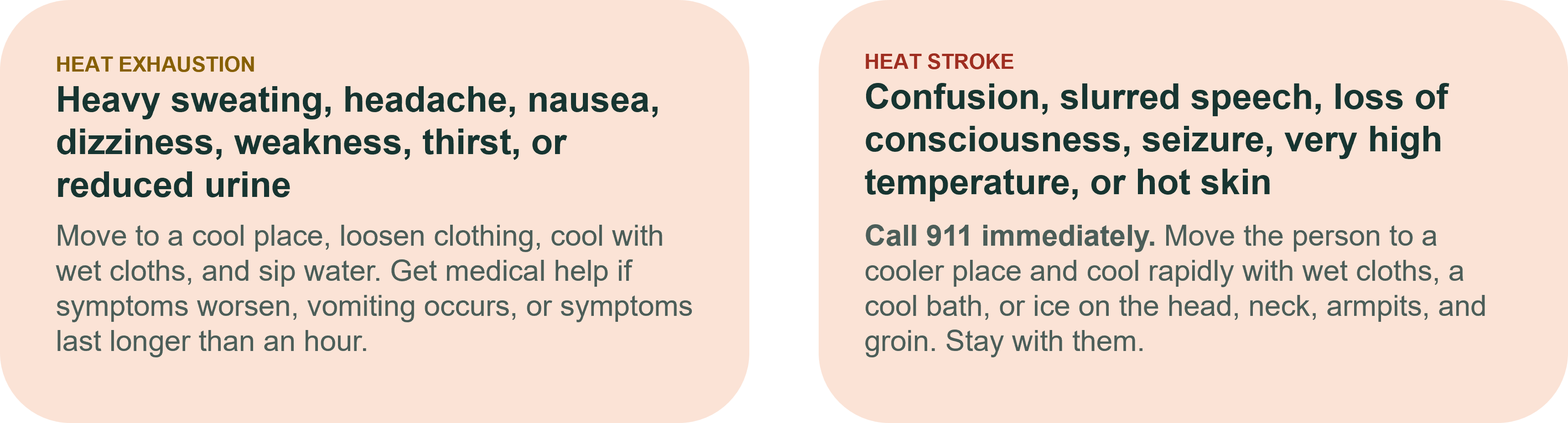
Check conditions. Have your plan. Know your resources.
For Air Quality Conditions: EPA AirNow
National Weather Service: Heat Safety Tips and Resources
Heat Forecast: National Weather Service Forecast Maps
Heat Risk by Zip Code: CDC Heat Risk
CDC Heat & Health: Advice
On the Go: Heat and Air Quality App for North Texas (HAQ) - Your Personal Climate Health Companion
Wildfire and Smoke Map: Wildfire Trackers
AirNow: Fire and Smoke Map
For local cooling centers, transportation, utility assistance, and language-access services, check your city or county website or call 2-1-1 where available.
Information resources do not replace advice from local officials and healthcare professionals. If you are experiencing an emergency, call 911.
Sign up for air pollution alerts and learn how you can help improve air quality at www.AirNorthTexas.org.
Please contact Daniela Tower with any other questions.