
Improve Mobility Options
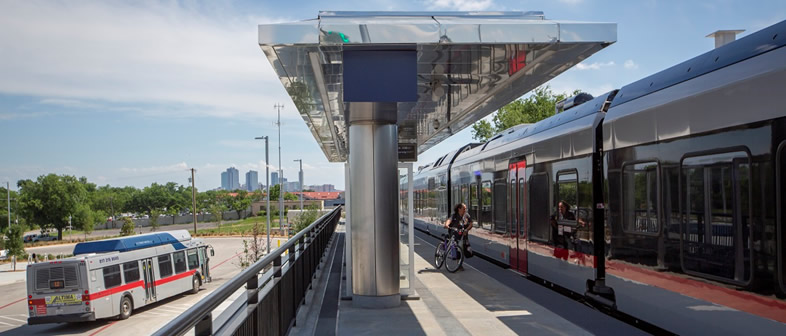
Providing convenient transportation options other than driving can reduce parking demand. Frequent transit service, walkable mixed-use communities, continuous bike lanes, sidewalks, bike parking/storage and similar efforts can encourage non-driving travel. In addition to multi-modal infrastructure, travel demand management (TDM) programs, which may include things such as transit pass subsidies or on-site carshare access, can also help reduce parking demand. Alternative transportation options should be frequently used and combined with multiple parking management strategies.
Key Benefits
Reduced Parking Demand – With more choices than just driving, fewer site tenants are dependent on parking and less likely to demand it.
Increased Value of Development – Developments in multi-modal locations are often more desirable as they tend to be active walkable neighborhoods or feature connections to trails and lively streetscapes. Denser mixed-use often creates more public taxable value as well.
Lowers Traffic Congestion – Reducing car-dependence can reduce area traffic impacts along with lower parking demand.
Encourages Denser Development – Reducing parking demand can increase development densities, optimizing the area’s economic and community-development potential.
Promotes Healthy Communities – Fewer car trips mean less ground-level air pollution and more active transportation like walking and biking that provides physical activity for users.
Implementation Considerations
Many tools and actions can enhance bicycle, pedestrian and transit accessibility and experience. These range from infrastructure actions like building sidewalks and transit lines to more programmatic actions like TDM. NCTCOG provides planning and funding assistance. Learn more through these programs as well as actions taken by the public and private sectors.
Bicycle-Pedestrian
Walk and Bike ThereTransit Management and Planning
Get There TogetherTravel Demand Management (TDM) 🚌
Find Your Best PathLand Use & Mobility Options
Region of ChoiceResponsible Party
Action
 Public Sector
- Build multi-modal infrastructure to plan for bicycle and pedestrian connectivity and facilities, and identify areas in need of pedestrian improvements for safe connection to remote lots and transit stations
- Coordinate with transit providers to offer services such as bus waiting areas with premium shelters, network maps and schedules, and seating
 Private Sector
- Build pedestrian and transit-oriented buildings with forms and designs that encourage multi-modal travel
- Build enhanced streetscapes with shade trees and wide sidewalks along streets around private developments
Shared Actions
Implement Travel Demand Management (TDM) programs to reduce roadway congestion by encouraging alternatives to solo driving, especially through amenities such as bike parking and maintenance, enhanced transit waiting areas and information kiosks, and information packets or sites on TDM programs from local governments.
Location
Alternative transportation options including TDM can be applied nearly everywhere but the options selected will be dependent on the context of transit services and density/land use.
Cost
Varies widely depending on the mobility option or service.
Timing
The strategy is most applicable to new developments with the ability to include improvements and start new programs, but it can also be applied to existing developments through retrofits or new services.
Technology
Technology can influence drivers to consider alternative transportation options largely by providing information. Dynamic pricing can also influence demand when leveraging technology. This can be achieved through information for drivers in the form of static signage, parking availability platforms, and mobile applications, or enforcement and managed technologies such as smart meters. For more information, see the Parking Technology Guide.
Case Studies
Santa Clara, CA
In 2024, the City of Santa Clara approved its Transportation Demand Management (TDM) program to shift trips away from driving alone, reduce parking demand, and ease traffic congestion. The TDM program is based on developers adopting TDM measures that may include, but are not limited to, providing bicycle lockers, transit passes, and access to carpooling programs. Implementing TDM strategies is a multistep process, and monitoring and reporting compliance typically continue throughout the life of the project. Developers are encouraged to work closely with City staff and/or third-party transportation consultants to select measures that are best suited to the project’s location and land uses. Such measures include land use, multimodal infrastructure, parking infrastructure and pricing, and broader TDM programs.
Source
Dallas, TX
Texas Instruments Inc. (TI), which employs 6,500 people, earned a Silver award from the League of American Bicyclists as a bike-friendly business. TI has formally supported alternative commuting for over 20 years and contributed close to $400,000 in direct funding and donated land to expand the Cottonwood Trail, connecting DART’s Forest Lane station to the western edge of the TI campus in North Dallas. TI has also installed long-term bike storage, onsite showers, and repair stations at its headquarters.
Source