
FRA Corridor ID Program: Fort Worth to Houston High-Speed Rail
Project Overview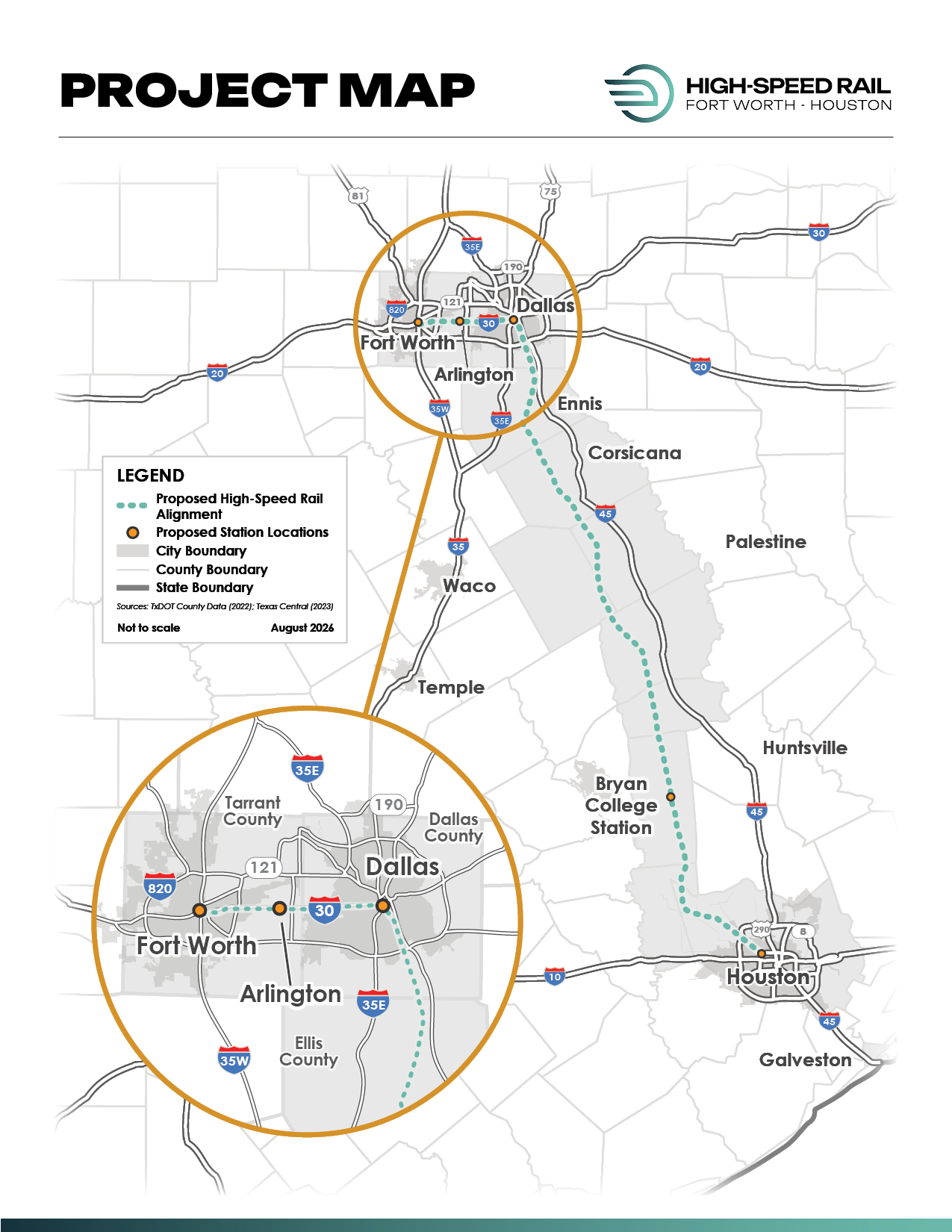
NCTCOG received a grant through the Federal Railroad Administration (FRA) Corridor Identification and Development (Corridor ID) Program to support the development of a Statement of Work (SOW), Budget and Schedule (Corridor ID Step 1) for the future development of a Service Development Plan (SDP) for the corridor. The proposed corridor is approximately 271 miles in length and is envisioned as a closed-system high-speed rail operation with speeds exceeding 200 miles per hour.
The Project is intended to connect major population and economic centers in Texas through a new high-speed passenger rail system. The corridor extends from Fort Worth through Arlington and Dallas in North Central Texas and continues south to Houston, with an intermediate connection in Grimes County, near Texas A&M University in College Station. Additional routes and connections will be evaluated as part of the planning process in Corridor ID Step 2.
Project Background
The Fort Worth to Houston high-speed rail corridor builds on two major planning efforts that have advanced separately over the past decade. The Dallas to Houston segment was developed through prior Texas Central Railroad (TCR), now Texas High Speed Rail Holdings, LLC. That effort included planning and environmental work, including completion of the federally led Environmental Impact Statement and issuance of a Record of Decision from the Federal Railroad Administration in 2020. At the same time, NCTCOG initiated the Dallas-Fort Worth High-Speed Transportation Connections Study led by the Federal Transit Administration, to evaluate and refine high-speed rail service between Fort Worth and Dallas, including alignment alternatives analysis, conceptual and preliminary engineering, environmental review, and operational planning.
While these efforts originated independently, they are increasingly viewed as parts of a single statewide mobility corridor connecting Fort Worth, Arlington, Dallas, and Houston. The two projects are at different stages of development and have been led through different planning and environmental processes, but both are centered on the same long-term vision of a dedicated high-speed passenger rail system in Texas. Evaluating the projects together creates an opportunity to assess how the corridor functions as one connected system rather than isolated segments. It also allows stakeholders, agencies, and the public to better understand the broader regional benefits, operational relationships, and long-term implementation considerations associated with a unified Fort Worth to Houston corridor.
Additional information on the FRA Corridor ID program can be found here: Corridor Identification and Development Program | FRA
Project Schedule
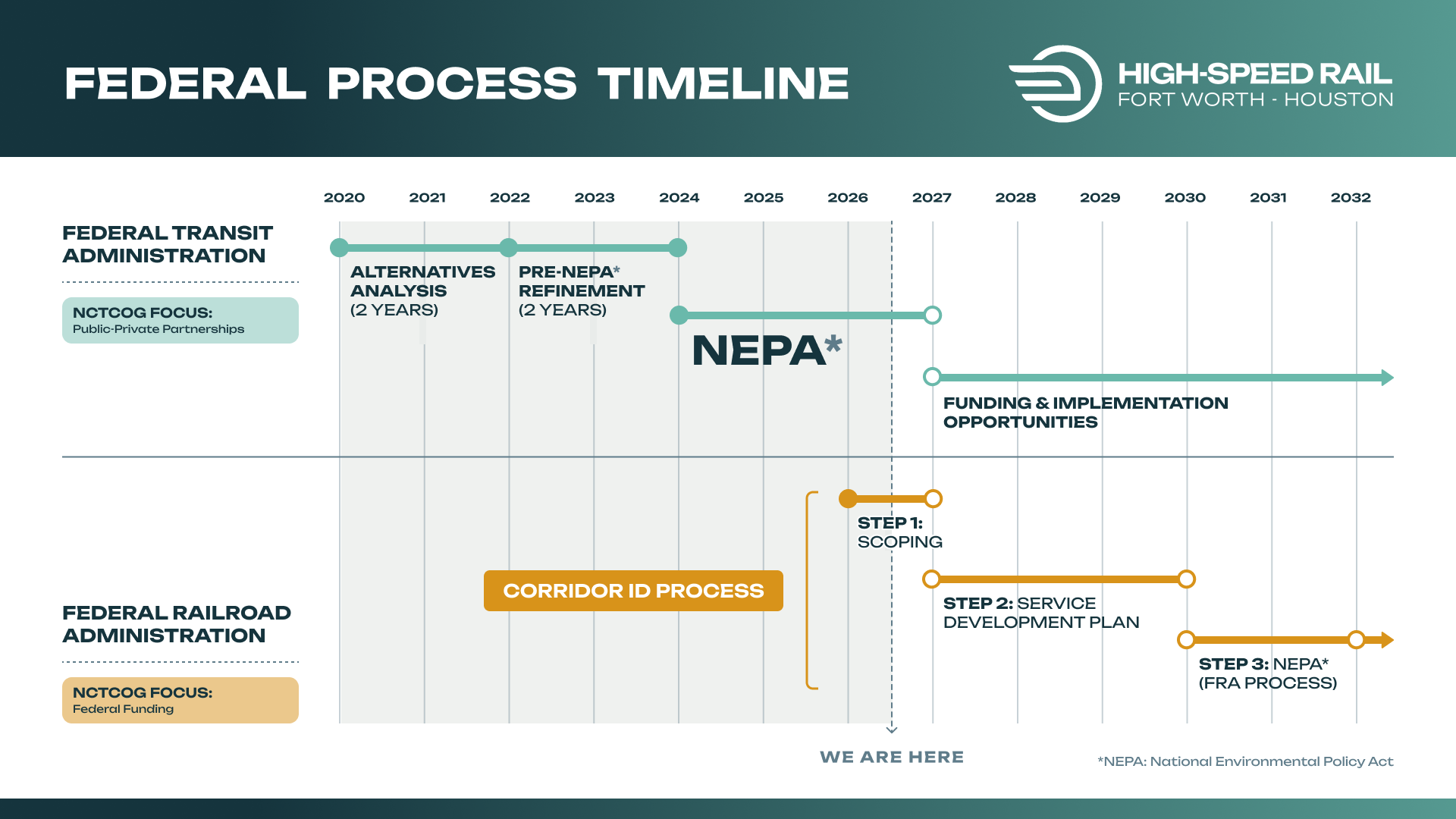
The schedule for main project activities for Step 1 and possible further Corridor ID program steps, as well as the concurrent work with the Federal Transit Administration for the Dallas-Fort Worth Corridor, is summarized in the graphic below.
Frequently Asked Questions
Study Report Materials
- TBD
Project Contact
| Ezra Pratt | Principal Transportation Planner |
.1c3ded.png "MicrosoftTeams-image-(3).png") epratt@nctcog.org epratt@nctcog.org |