
Shared Parking
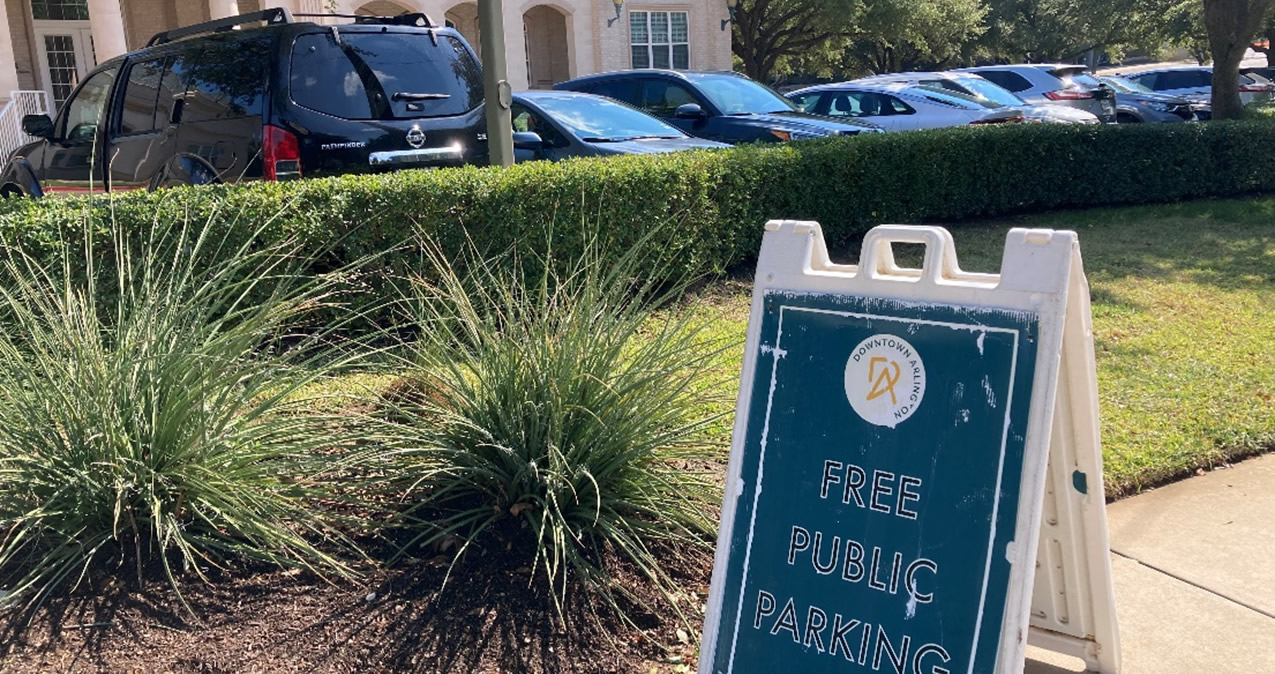
Shared parking agreements allow property owners to expand their parking capacity during peak demand by partnering with other properties whose needs peak at different times. For example, a restaurant might use a nearby bank’s parking lot after 6 pm and on weekends when the bank is closed or a brewpub might share parking with a co-working space during off hours.
Shared parking should reduce the net supply across multiple land uses. This reduces the land and costs dedicated to parking, freeing it up for other purposes. Adding the total amount of parking for two land uses in one facility that would have been built separately does not count as shared parking as it does not meet the intent. In North Texas public parking often fills the role of shared parking, especially in walkable downtowns; see the Public-Private Development strategy for more information.
Key Benefits
Save Money While Having Enough Parking – Through the efficient use of parking spaces, shared parking reduced the net cost of parking meaning less cost of construction and/or land dedicated to parking.
Anywhere in North Texas – Shared parking works wherever two or more land uses have different peak activity times. No transit or location downtown is required but the uses must be walkable to each other.
Support Infill – Shared or public parking avoids the need for excessive lots or garage space which supports more density or preserving existing structures.
Maximizing Current Parking Supply – Parking use is maximized throughout the day by serving land uses with different demand peaks (e.g. residential and office).
Implementation Considerations
The decision to share parking is a private developer/owner decision. City code must authorize and approve when parking is required.
Responsible Party
Action
 Public Sector
- Legalize shared parking agreements that allows a reduction in net minimum parking requirements
- Negotiate shared parking agreements between property owners if needed
- Provide technical assistance and example agreements to private partners
- Revise zoning code to incentivize/allow shared parking
 Private Sector
- Initiate shared parking agreement proposals with development projects
- Determine agreement between private parties and in compliance with city code as necessary
- Help the public sector confirm key challenges and issues towards a shared agreement
Location
Shared parking can apply to new buildings or existing properties, wherever two or more land uses have different peak activity times. No transit or location downtown is required if the land uses are walkable to each other.
Cost
Shared parking may require time and legal services to coordinate and create an agreement. This should be offset by savings from having fewer parking spaces to construct.
Timing
The strategy applies to new development and may often be part of the zoning approval process. It can also be applied to existing buildings or properties with redevelopment.
Technology
A range of technologies can be used to help drivers identify shared parking availability, including parking guidance systems, dynamic wayfinding and signage, static signage, parking availability platforms, and mobile applications. See the Parking Technology Guide for more information.
Case Studies
Portland, OR
The City of Portland implemented a Shared Parking Program under the Northwest Portland Parking Management Program Management Plan to improve parking availability, reduce congestion and encourage collaboration among property owners, businesses, and residents. Following its implementation several property owners opened their parking lots to the public; however, some owners raised concerns about maintenance and operating cost. To address these concerns the Stakeholder Advisory Committee allocated parking meter revenue funds to help cover initial capital investments. Reimbursement funds may be distributed to parking lot owners who agree to share their parking spaces with residents or participate in pilot programs for employees, subject to specific agreements.
Source
Source
New Braunfels, TX
New Braunfels added Shared Parking agreements to its downtown zoning code in 2007 to support its growth and redevelopment. These agreements permit shared parking in the case of mixed use (different buildings) under specific conditions. For instance, up to 50% of parking spaces required for theaters, evening entertainment venues, or churches may be shared with banks, offices, and similar businesses that close in the evening. Applicants must submit a Shared Parking Agreement for on-site or an off-site parking application, with Planning Director approval based on a peak study showing different peak usage times.
Source
McKinney, TX
Shared parking spaces may be allowed under specific circumstances in the City of McKinney. The Development Code for the McKinney Town Center lists shared parking as a “public benefit” to help it gain approval in the zoning process. In 2017, the city signed a long-term lease agreement with a downtown-adjacent church, opening its parking lot for public use. Public parking is permitted all times but Sunday mornings when church services are held. The agreement has been successful, taking a lot that was typically vacant and now used more often by downtown patrons. The City of McKinney is continuing to approach other properties to provide a near-term, cost-effective solution to a parking management problem.
Source
Source