
Wayfinding, Markings, and Signage
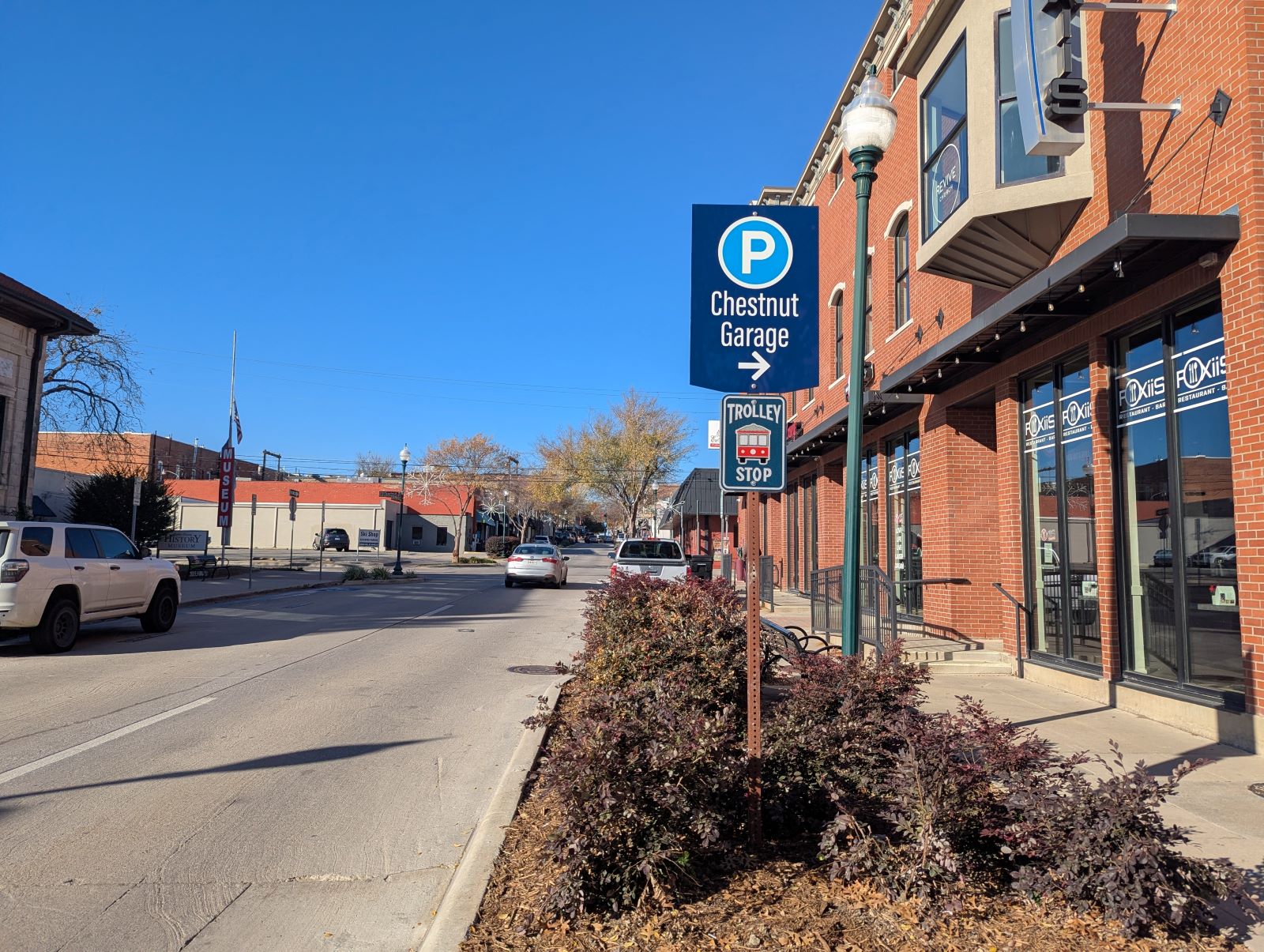
How drivers find parking is essential to the overall efficiency of parking operations. Wayfinding in this context refers to the tools and techniques used to orient and navigate users to parking. It includes both static and digital signage, markings like street and curb painting, guidance systems, online information, and more. These techniques should create a more predictable, easy-to-understand parking experience. The methods used for wayfinding can be scaled to different contexts and should be used in combination with other management strategies.
Key Benefits
Improves Efficiency – Connecting drivers more quickly with open spaces can improve the net use and turnover of parking facilities.
Improves Safety and Enforcement – Clear signage and paint reflecting rules can improve compliance and keep key locations like intersections and priority spaces open to improve visibility of traffic and pedestrians.
Reduces Confusion and Conflicts – Reduces potential conflicts between various uses of curb space and reduces driver confusion about when and where parking is legally permitted.
Reduces Congestion – Reduces congestion by getting drivers off the road and into parking spaces sooner when open spaces are easier to find.
Implementation Considerations
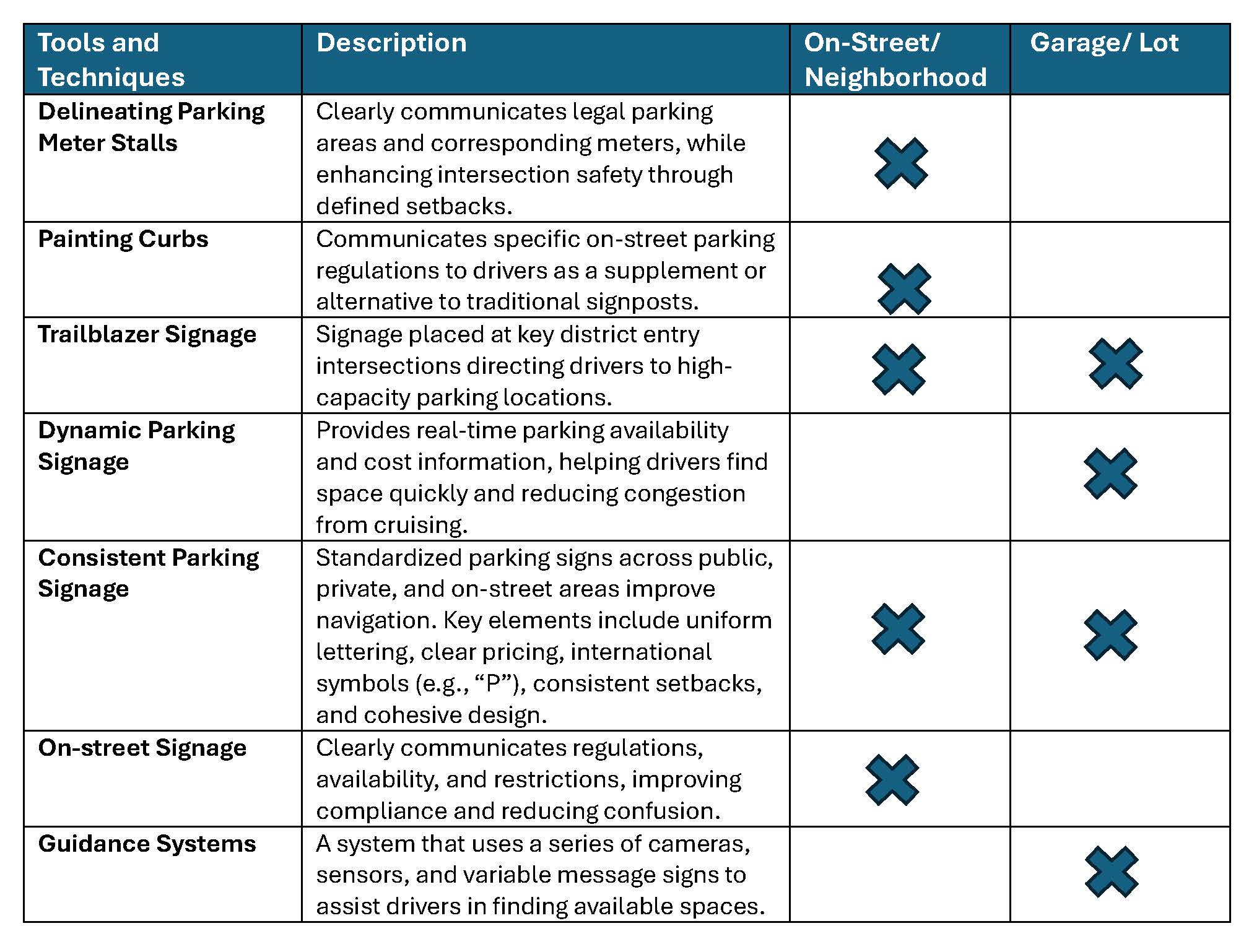
The multiple wayfinding types – location identification, directional, informational, and regulatory – encompass both physical forms such as paint, static and dynamic signage, and digital tools such as parking availability platforms. These tools can also be applied at the neighborhood level (usually public sector led) and property level (typically private sector led). Static signage is more common at the neighborhood level while dynamic displays and guidance systems are usually applied at the level of a parking facility. The table below shows the relationship of common wayfinding/signage techniques to their typical area of application.
Shared Actions (Public or Private)
On-Street
- Coordinate between public and private stakeholders on the possibility of implementing a district-level consistent parking signage brand or standards
- Periodically review the effectiveness of parking wayfinding, markings and signage program through surveys, parking utilization data, and customer feedback
- Develop shared communications materials to educate the public on new wayfinding systems and signage
Off-Street
- Share data and information on parking facility’s occupancy, restrictions, regulation with local public and private stakeholders in district settings
- Prioritize wayfinding to large capacity parking locations that are currently underutilized in high demand areas
Responsible Party
Action
 Public Sector
- Update city codes and ordinances to allow new signage and enforce design standards through zoning and building regulations.
- Publish simple maps and parking information for key districts where public parking is provided.
- Lead planning and coordination efforts in developing a citywide or district level signage master plan for parking.
- Inventory current wayfinding, signage, and marking systems across all parking facilities and identify gaps and redundancies.
- Allocate budget for public signage installation and maintenance in right-of-way areas and on street.
 Private Sector
- Explore usage of dynamic parking signage with real-time parking availability at parking facilities.
- Coordinate with public agencies to align with public standards and ensure consistency with the city and/or district.
Location
Wayfinding, markings and signage are needed in many parking contexts. Highest need typically includes mixed-use walkable districts, large parking facilities, or structured parking with multiple users. It is also important for on-street curb parking.
Cost
May include the design/planning, purchase, and installation. Small static signage is likely cheaper in the range of $20 to $150 per sign. More dynamic signage and sensors for wayfinding or live occupancy can range from $250 to $800 per space. Compared to the cost of building a new surface or garage parking, technology options are relatively cheap.
Timing
The strategy applies to new development or redevelopment and is often applied to existing developments.
Technology
Signage and marking are a form of technology often integrated with other parking information technologies like parking availability platforms and mobile applications. See the Parking Technology Guide for more information.
Case Studies
Static Signage
Alexandria, VA
The Alexandria Wayfinding Program includes the creation of consistent parking signage standards for identification and directional signs making public and private parking facilities easier to locate. The City of Alexandria, Virginia has led efforts to maintain a cohesive visual identity by establishing uniform parking sign standards throughout the city. Their published Wayfinding Manual requires parking signage prominently feature a “P” icon as the main message, along with standardized size, height, and lighting requirements. Signs for privately operated facilities include the operator’s logo on the foot panel, while publicly operated facilities display the City of Alexandria’s name.
Source
McKinney, TX
The City of McKinney Downtown parking management action plan promotes wayfinding and parking awareness initiatives to improve asset utilization, enhance the visitor experience, assist with trip planning, and better direct drivers to available parking. To achieve these goals, the following recommendations were proposed.
- Increase public awareness of parking options
- Design a public brand and wayfinding plan
- Update the pedestrian wayfinding signage
- Procure a digital parking guidance system
- Integrate real-time availability data with other applications
The city also created a map of public parking on their website and uses uniformly formatted signage to indicate parking at lots and garages. Since most parking is on the periphery of downtown, the city operates a free “Downtown Trolley” (14-passenger shuttle bus) from the lots and garages to the center of downtown.
Source
Dynamic Signage
Redwood City, CA
Redwood City has launched a Downtown Parking Guidance System designed to deliver real-time parking availability information to visitors in the downtown area. This includes the installation of parking sensors and wayfinding signage across key locations. Small-format circular signs are placed on poles throughout downtown to direct drivers to available spaces, while five larger gateway signs were installed at major entry points to provide advance notice of parking availability. This system aims to streamline the parking experience by helping visitors quickly locate open spots, minimizing traffic caused by vehicles circling for parking, and enhancing the overall accessibility and experience of downtown Redwood City.
Source
Source
Plano, TX
Legacy West is a major mixed-use development in northwest Plano, Texas with substantial parking demand. In response to this challenge, real-time parking inventory signage was installed throughout the district’s shared garage. The goal of this system is to help drivers navigate to open parking spaces in the over 3,200 space garage facing the Dallas North Tollway. The signage can help reduce traffic congestion within the development, shortening the time visitors spend searching for parking, and enhance the overall customer experience.
Source